
Sourcing an Automated Coffee machine in 2026 requires more than comparing prices and touchscreen features. Buyers must examine brewing consistency, payment systems, cleaning demands, energy use, software support, and long-term service coverage. A machine may look impressive in a showroom, yet perform poorly during a busy morning rush. That gap matters.
Coffee expert James Hoffmann has often expressed a simple principle: “The best coffee is the coffee you like.” His point applies to automated equipment, too. The best machine is not always the most advanced model. It should match the operator’s menu, customer expectations, location, and staff capabilities. A compact office unit needs different strengths than a high-volume self-service kiosk.
This guide explores how to source Automated Coffee machines with practical judgment. It considers bean quality, grinder adjustment, milk systems, cup capacity, interface design, remote monitoring, warranties, and local technical support. Buyers should request live demonstrations and test several drinks, including espresso, milk coffee, and decaffeinated options. Ask suppliers about cleaning time. Ask for failure-response data. Small details become expensive quickly.
Some uncertainty remains. Forecasts can change, and new hardware may not age well. A cheaper machine may create higher labor costs through frequent cleaning or repairs. A premium unit may still disappoint without reliable installation. Therefore, procurement should combine supplier evidence, user feedback, and a realistic site trial. Convenience is valuable. Consistency is better. The final decision should serve the customer, not merely the machine’s specification sheet.
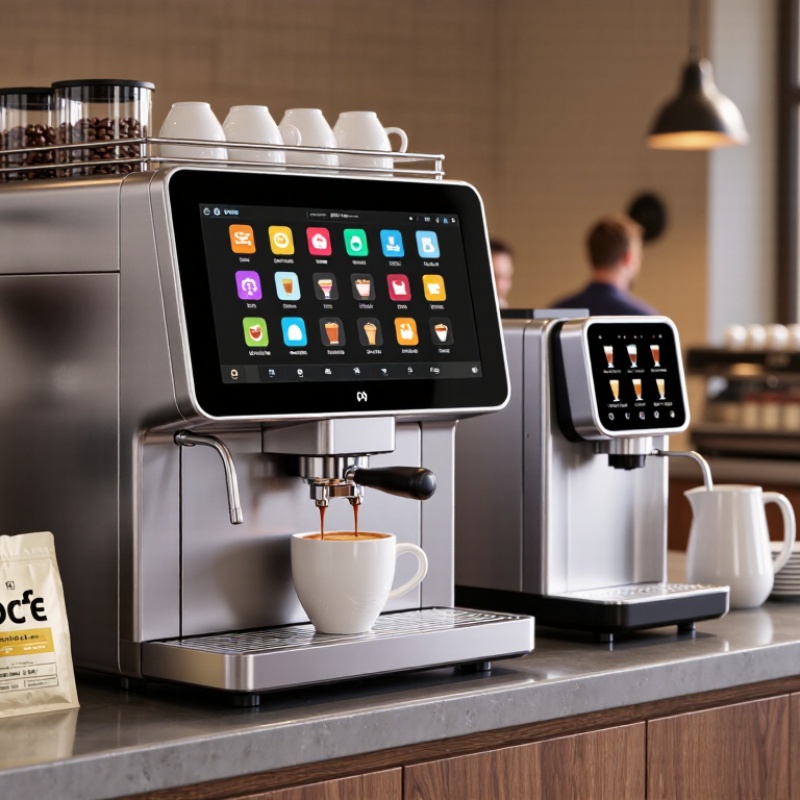
How to Source Automated Coffee Machines in 2026?
Define the Automated Coffee Machine Sourcing Requirements
Start with the operating scene, not the machine catalogue. Measure daily cups, peak-hour demand, drink recipes, water quality, counter space, and staff skill. A self-service kiosk may need faster recovery, while an office machine may value quiet operation. The International Coffee Organization reported global coffee consumption at approximately 177 million 60-kilogram bags in 2022/23. Demand is large, but sourcing decisions remain local. Define a target output, such as 120 cups daily and 25 cups per hour during peak periods. Include cup sizes, milk options, brewing temperature, grinder settings, cleaning time, and payment integration.
Tips: Build a requirement sheet before requesting quotations. Ask suppliers for verified cycle-time data, warranty limits, spare-part availability, and remote diagnostic functions. Request a live demonstration using your preferred beans and water. Measure waste, noise, cleaning steps, and recovery time. Small details matter.
Calculate total cost of ownership, not only purchase price. Include installation, filtration, consumables, energy, software fees, servicing, and expected downtime. ENERGY STAR guidance shows that commercial food-service equipment can reduce operating energy through efficient design and controls, but actual savings depend on usage. Require documented energy data under realistic daily conditions. I would also test accessibility and cleaning ergonomics. A machine can look advanced yet frustrate staff after three busy hours. A perfect forecast is impossible. Leave room for seasonal demand, menu changes, and human error. Compare at least three technically equivalent proposals before approving the specification.
| Requirement Dimension | Recommended Sourcing Requirement | Reference Data / Target Range | Validation Criteria | Priority | Unit |
|---|---|---|---|---|---|
| Intended Location | Choose the machine according to the installation environment and expected traffic. | Office, hotel, convenience store, university, transport hub, or unattended retail site. | Confirm available floor space, customer flow, supervision level, security, ambient temperature, and access for delivery and maintenance. | Must-have | Use case |
| Daily Beverage Volume | Specify the expected average and peak number of beverages served per day. | Light duty: up to 80 cups/day; medium duty: 80–200 cups/day; high duty: more than 200 cups/day. | Request a documented duty cycle and verify performance during a continuous workload test rather than relying only on maximum theoretical output. | Must-have | Cups/day |
| Peak Throughput | Define the required service speed during busy periods. | Typical target: approximately 30–60 seconds for a black coffee; milk-based drinks may require more time. | Measure order-to-cup time with the selected recipes, cup sizes, milk system, cleaning prompts, and payment process enabled. | Must-have | Seconds/cup |
| Beverage Menu | Specify the exact drinks and customization options required for launch. | Common requirements include espresso, americano, coffee, cappuccino, latte, hot water, adjustable strength, and multiple cup sizes. | Check recipe consistency, drink temperature, dispensing sequence, powder or bean dosing, allergen separation, and menu change procedures. | Must-have | Menu |
| Coffee Ingredient System | Select bean-to-cup, soluble, capsule, or hybrid architecture based on operating priorities. | Bean-to-cup supports freshly ground coffee; soluble systems generally simplify storage and cleaning; hybrid systems combine both approaches. | Compare taste, waste, ingredient shelf life, grinder durability, calibration requirements, refill frequency, and cost per serving. | Must-have | System type |
| Milk Solution | Define whether the machine needs fresh milk, chilled milk, powdered milk, or a plant-based milk option. | Fresh-milk systems require refrigeration and stricter cleaning; powdered systems normally offer longer storage and simpler logistics. | Verify refrigeration temperature, milk-line cleaning, allergen controls, maximum hold time, waste handling, and compatibility with required recipes. | Must-have | Configuration |
| Water Supply | Choose a plumbed-in or water-tank configuration according to the site. | Plumbed-in installation is suitable for high-volume sites; tank-fed models are useful where permanent water connections are unavailable. | Confirm inlet pressure, filtration, drain requirements, tank capacity, refill frequency, leak protection, and water-quality requirements. | Must-have | Configuration |
| Electrical Requirements | Match the machine to the destination country's electrical infrastructure. | Common commercial configurations include 220–240 V AC or 110–120 V AC, with power demand often ranging from approximately 1.5–4.0 kW. | Request the exact rated voltage, frequency, maximum current, plug type, circuit protection, standby consumption, and installation instructions. | Must-have | Electrical |
| Physical Footprint | Set maximum external dimensions and service-clearance requirements before requesting quotations. | Many countertop and freestanding commercial machines occupy roughly 0.3–1.0 m² of floor or counter area, excluding service clearance. | Collect width, depth, height, net weight, door-opening clearance, ventilation clearance, loading route, and anchoring requirements. | Must-have | mm / kg |
| Cup Compatibility | Define the required cup material, diameter, height, and size range. | Typical beverage sizes include approximately 180–350 ml, but the final range depends on the menu and dispensing layout. | Test paper, plastic, and reusable cups where applicable; verify cup detection, dispensing accuracy, lid clearance, and spill prevention. | Must-have | ml / mm |
| User Interface | Specify the interface required for self-service operation. | Common requirements include a touchscreen, multilingual interface, accessibility controls, clear allergen information, and guided maintenance prompts. | Conduct usability tests for menu selection, payment confirmation, error messages, language changes, accessibility, and recovery after an interrupted order. | Should-have | Interface |
| Payment Acceptance | Identify the payment methods required in the target market. | Potential options include contactless cards, mobile wallets, QR payments, cash, and closed-loop cashless accounts. | Confirm payment-terminal compatibility, transaction security, offline behavior, refunds, settlement reporting, and local regulatory acceptance. | Must-have | Payment |
| Connectivity | Require remote monitoring when the machine will operate across multiple locations. | Useful functions include cellular or Wi-Fi connectivity, stock alerts, fault notifications, sales reports, telemetry, and remote configuration. | Check supported networks, data ownership, API availability, cybersecurity controls, software-update policy, user permissions, and service continuity during connectivity loss. | Should-have | Digital |
| Ingredient Capacity | Size ingredient hoppers and reservoirs to match the refill schedule. | Set capacity according to recipe consumption and the required number of unattended operating days; avoid selecting capacity only by physical volume. | Calculate servings per refill using actual dosage, ingredient density, waste, peak demand, and minimum reserve levels. | Must-have | Servings/refill |
| Cleaning and Hygiene | Define mandatory daily, weekly, and periodic cleaning tasks. | Requirements commonly include automatic rinse cycles, removable food-contact parts, milk-system sanitation, descaling, waste-container emptying, and cleaning logs. | Review the cleaning procedure, chemical requirements, cycle duration, operator training, food-contact materials, and compliance with local food-safety rules. | Must-have | |
| Waste Management | Specify separate handling for coffee grounds, liquid waste, packaging waste, and rejected products. | Waste capacity should cover the planned service interval, with liquid drainage preferred for high-volume or continuously staffed sites. | Measure waste-container capacity, fill-level detection, odor control, leakage prevention, emptying time, and disposal requirements. | Must-have | Capacity / service |
| Temperature and Extraction | Set measurable beverage-quality limits instead of using subjective descriptions. | For many hot coffee applications, a dispensing temperature around 65–85°C is a practical test range, subject to recipe and safety requirements. | Test temperature at dispensing and after a defined time, along with extraction time, beverage volume, strength, repeatability, and thermal recovery. | Must-have | °C / seconds |
| Reliability | Require documented reliability data and a defined service-life expectation. | Use a target of at least 95% operational availability for unattended commercial deployment, subject to agreed measurement rules. | Define uptime, excluded downtime, failure categories, restart behavior, preventive-maintenance intervals, and acceptance-test duration. | Must-have | % uptime |
| Serviceability | Minimize the time and skill required for routine maintenance. | Prioritize tool-free access, modular components, clear fault codes, replaceable wear parts, and remote diagnostics. | Measure mean time to repair for common failures, required tools, spare-part lead time, technician training, and local service coverage. | Must-have | Maintenance |
| Compliance and Safety | Require market-specific electrical, electromagnetic, food-contact, radio, and safety documentation. | Documentation may include applicable conformity declarations, test reports, food-contact material records, electrical safety files, and wireless approvals. | Verify that certificates and technical files match the exact model, configuration, destination market, voltage, connectivity module, and production version. | Must-have | Documentation |
| Security | Protect the machine, payment functions, ingredients, and customer data. | Relevant controls include locked service panels, tamper detection, role-based access, encrypted communication, secure updates, and audit logs. | Request a security architecture summary, vulnerability-response process, password policy, update mechanism, data-retention policy, and incident-notification procedure. | Must-have | Security |
| Total Cost of Ownership | Evaluate the complete operating cost rather than purchase price alone. | Include equipment, freight, installation, payment fees, ingredients, consumables, electricity, water treatment, cleaning chemicals, maintenance, software, and downtime. | Request a five-year cost model using the same beverage volume, recipe, utility price, labor assumptions, service interval, and replacement-part assumptions. | Must-have | Currency/cup |
| Pilot and Acceptance Test | Require a site pilot before committing to a large rollout. | Use a representative pilot covering normal operation, peak demand, refill cycles, cleaning, payment, connectivity loss, and fault recovery. | Approve the purchase only after meeting agreed thresholds for quality, throughput, uptime, waste, user experience, hygiene, and service response. | Must-have | Test phase |
| Sustainability | Include energy, packaging, material durability, repairability, and end-of-life requirements. | Assess standby energy, automatic sleep mode, water efficiency, recyclable packaging, replaceable parts, refurbishment options, and product take-back arrangements. | Request measured energy data, material declarations, expected component life, repair documentation, and disposal guidance for electrical and electronic equipment. | Should-have | Lifecycle |
| Commercial Terms | Define procurement and delivery conditions before comparing offers. | Specify required quantity, pilot quantity, production lead time, warranty duration, spare-parts availability, training, installation, and Incoterms. | Compare quotations using identical specifications and require written confirmation of inclusions, exclusions, warranty remedies, service-level targets, and change-control procedures. | Must-have | Contract |
A compact capsule machine usually fits best. It offers simple operation, fixed portions, and limited cleaning. Very practical.
Choose one for offices, waiting areas, and self-service locations. It grinds whole beans before brewing. Check refill access and cleaning effort.
Measure recovery time between drinks and tested hourly output. Morning demand can expose weak performance. Marketing figures may disappoint.
Check grinder adjustment, brewing temperature, milk hygiene, and recipe customization. Test touchscreens with wet fingers. Physical controls may survive heavy use better.
Request factory audits, traceability records, quality data, and testing procedures. Confirm technician response times and spare-part availability. Vague support answers are warning signs.
Request current documents for electrical safety, electromagnetic compatibility, food-contact materials, and environmental requirements. Verify them independently with recognized testing bodies. A logo alone proves little.
Videos cannot reveal noise, cleaning difficulty, or inconsistent drinks. Test several recipes with your beans, milk, cup sizes, and temperatures. Short tests can hide long-use problems.
Confirm unit price, minimum order quantity, tooling, packaging, shipping, warranty, and spare parts. Also clarify installation, training, and remote support. Cheap units can become costly later.
Provide drawings for the cabinet, screen language, payment interface, and recipe controls. Ask which changes need tooling or software work. Keep every promise in writing.
A two-week pilot can reveal leaks, awkward refill doors, and confusing prompts. Record every fault, including small delays. A perfect machine may not exist.
Sourcing Automated Coffee Machines in 2026 requires a structured approach that begins with clearly defining your operational needs, target users, expected drink volume, available space, budget, and desired level of automation. Compare different machine types according to intended use cases, drink variety, payment options, user interface, maintenance requirements, energy efficiency, and integration capabilities. This process helps ensure that the selected equipment matches both customer expectations and business objectives.
Next, assess suppliers through their production experience, certifications, quality-control procedures, and ability to provide reliable technical documentation. Request samples, detailed quotations, lead times, warranty terms, and information about customization options before making a decision. Finally, carefully verify contract conditions, shipping responsibilities, installation procedures, staff training, spare-parts availability, and after-sales support. A thorough evaluation of these factors can reduce purchasing risks, improve long-term operating efficiency, and help buyers build a dependable Automated Coffee service for changing market demands.
