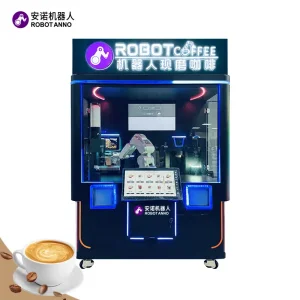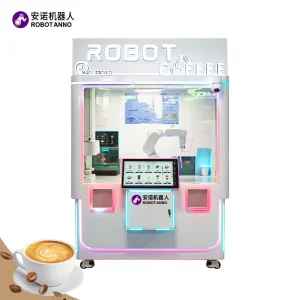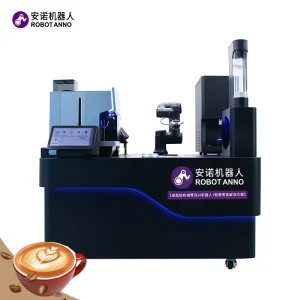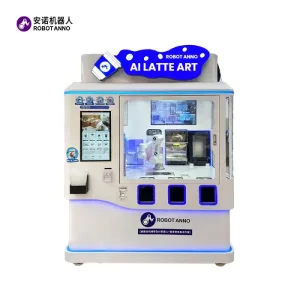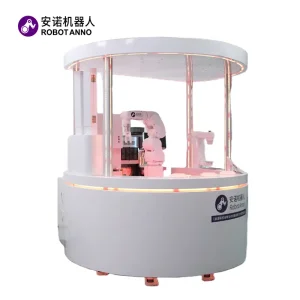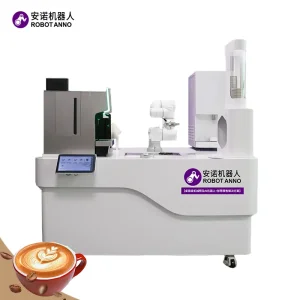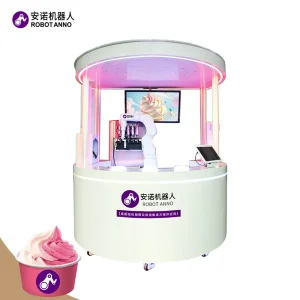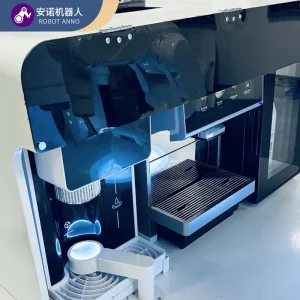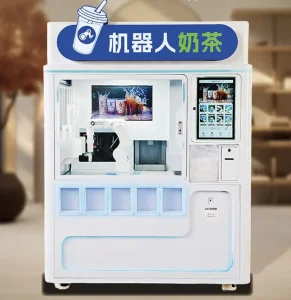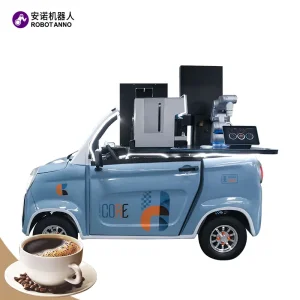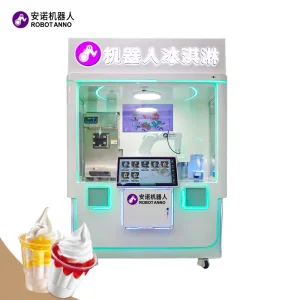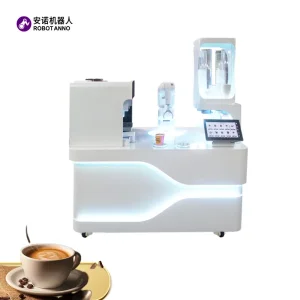
Discover our CE, FCC, and ISO9001-certified enclosed robotic coffee bars and master kiosks designed for 24/7 continuous autonomous deployment worldwide.
The global commercial coffee market is currently undergoing a structural transformation driven by two intersecting economic headwinds: escalating labor costs and acute real estate inflation in prime commercial corridors. Traditional human-operated cafes face razor-thin operating margins, high employee turnover rates (often exceeding 120% annually in fast-casual food service), and inconsistent beverage extraction quality. Simultaneously, conventional open vending machines struggle with consumer perception regarding hygiene, taste depth, and lack of visual engagement.
This structural challenge has accelerated the adoption of Closed Coffee Robots and Enclosed Robotic Coffee Machines. Unlike legacy vending units or open-counter robotic arms, a fully enclosed coffee robot integrates a controlled, dust-free micro-environment with high-precision industrial robotics, commercial espresso boilers, automated milk frothing, and cloud-connected IoT telemetry.
Enclosed kiosks operate under positive air pressure with optional HEPA H13 filtration and UV-C sterilization chambers. This eliminates airborne particulate contamination, insects, and human contact hazards—achieving strict NSF/ANSI Standard 2 and HACCP compliance for public deployment.
By removing human shift constraints, closed robotic coffee machines can operate continuously for 24 hours a day, 365 days a year. The average drink cycle time ranges from 45 to 75 seconds per cup, delivering peak throughputs exceeding 50 to 80 cups per hour.
With an average footprint under 2.5 to 3.5 square meters, closed coffee kiosks eliminate full-store buildout costs. Operating margins increase significantly due to zero direct labor expenses, resulting in typical capital payback periods of 6 to 11 months depending on footfall density.
| Operational Dimension | Traditional Coffee Shop | Open Robotic Arm Bar | Closed Coffee Robot (Anno System) |
|---|---|---|---|
| Footprint Required | 30 m² – 150 m² | 8 m² – 20 m² | 1.8 m² – 3.5 m² |
| Hygiene Isolation | Manual (Human Risk) | Open Air Exposure | Enclosed UV-C + Sealed Glass |
| Daily Operating Hours | 8 – 14 Hours/Day | 10 – 16 Hours/Day | 24/7 Unattended Continuous |
| Brewing Consistency | Variable (Operator Dependent) | High (Robot Controlled) | Ultra-High (PID + AI Vision) |
| Direct Labor Cost | $4,000 – $15,000 / Month | $1,500 – $3,500 / Month | $0 (Routine Stocking Only) |
| Payback Period | 24 – 36 Months | 14 – 18 Months | 6 – 11 Months |
Underneath the tempered glass aesthetic of a industrial-grade closed coffee machine lies a synchronized ecosystem combining multi-axis motion control, thermal extraction hydraulics, and automated cleaning CIP loops.
Our enclosed systems utilize either a 6-Axis Articulated Industrial Robotic Arm (J/SJ Series) or a high-speed 3-Axis Cartesian/SCARA Mechanism with repeat positioning accuracy of ±0.05 mm. Motors are industrial-grade brushless AC servos with absolute optical encoders, ensuring smooth cup handling without fluid spillage during acceleration.
Equipped with dual independent stainless-steel boilers (1.5L extraction boiler + 3.0L steam boiler) driven by commercial rotary vane pumps operating at a constant 9-bar pressure. PID temperature control algorithms regulate water heat within ±0.5°C tolerance, guaranteeing optimal bean extraction (18%-22% yield ratio).
Integrated medical-grade peristaltic dosing pumps draw fresh refrigerated milk (kept at a constant 2°C–4°C in an internal thermoelectric cooling unit). Superheated dry steam is dynamically injected to create silky micro-foam (micro-bubbles < 0.2mm) suitable for detailed automated latte art artwork.
A closed coffee machine requires minimal manual cleaning. An integrated Clean-In-Place (CIP) system performs high-temperature 92°C water flushes and sanitizing solution cycles automatically every 24 hours or after a configured number of cups, rinsing grinder chutes, milk hoses, and brew groups.
Featuring dual commercial flat-burr grinders (64mm/74mm hardened titanium steel blades) with micrometer-level step adjustment. Sensor arrays continuously monitor grind resistance and ambient humidity, dynamic adjusting grind time to maintain exact dose weights (e.g., 18g ± 0.2g for double espresso).
Internal RGB-D camera sensors inspect cup presence, cup lid placement, and drink filling levels in real-time. Exterior interactive touchscreen displays (21.5" to 32" industrial IP65 capacitive glass) offer intuitive ordering, customizable sweetness/ice/milk ratios, and dynamic video advertising.
OEM/ODM Technical Customization: RobotAnno provides modular manufacturing options for global suppliers. Chassis configurations can be customized with dual-arm capabilities, integrated ice flake makers, automatic cup sealing modules, syrup dosing arrays (up to 8 distinct flavors), and customized exterior branding panels.
As a premier OEM/ODM manufacturer in Shenzhen, RobotAnno has deployed closed coffee robots and automated beverage kiosks across more than 60 countries and regions worldwide.
Market adoption trends vary by region but reflect a unified trajectory toward fully automated, contactless retail solutions:
Navigating international electrical, food hygiene, and payment standards is critical for international distributors and fleet operators.
RobotAnno closed coffee robots carry full EU CE Certification (Machinery Directive 2006/42/EC, Low Voltage Directive 2014/35/EU, EMC 2014/30/EU), US FCC Certification, and are manufactured in compliance with ISO9001 Quality Management Systems. Food contact parts use NSF-certified silicone tubing and 304/316 food-grade stainless steel.
Supported by standard MDB (Multi-Drop Bus) 4.3 and Executive protocols. Native integration with Nayax VPOS Touch, Pax IM30, Ingenico, and QR-code scanner modules. Compatible with local credit cards, RFID employee badges, Apple Pay, Google Wallet, and regional mobile wallets.
Our centralized SaaS management portal provides operators with real-time operational visibility. Features include stock level alerts (coffee bean levels, milk volumes, cup counts), revenue analytics, error diagnostics, remote recipe adjustment, and Over-The-Air (OTA) firmware updates.
Enclosed coffee robots thrive in locations where traditional cafe operations are economically non-viable due to space constraints, high rents, or non-standard operational hours.
High footfall, continuous 24-hour demand, and travelers seeking fast, premium coffee without waiting in long barista lines. Compact enclosed design fits perfectly in departure gates, train platforms, and security concourses.
Offers employee perk programs or paid retail coffee directly within office building lobbies. Integrates with corporate ID access badges for cashless employee subsidies and fast morning rush-hour throughput.
Medical staff, patients, and visitors frequently require quality hot beverages during late-night shifts. The enclosed, dust-isolated environment meets stringent hospital hygiene standards while operating 24/7 uninterrupted.
Acts as an interactive retail attraction that draws foot traffic. The visible robotic movement behind clear tempered glass provides visual entertainment while generating high-margin beverage sales in high-rent atrium areas.
Complements student lifestyle habits with instant ordering via smartphone apps, customized syrup/milk choices, and late-night library availability during examination periods.
Configured with IP54/IP65 weatherized outer shells, climate control HVAC units, and anti-vandalism reinforced glass, closed coffee kiosks can operate as standalone outdoor micro-cafes in public parks and tourist sites.
RobotAnno’s Shenzhen R&D center is actively pioneering next-generation autonomous beverage technologies to drive the market forward.
Over the next three to five years, the enclosed coffee robot sector will evolve beyond scripted mechanical automation into fully adaptive, generative AI-driven commercial beverage platforms:
Integrating large language models (LLMs) and voice AI allows customers to converse naturally with the robotic kiosk (e.g., "Make me a low-calorie iced latte with a nutty flavor profile"). The machine dynamically formulates recipe proportions on the fly.
Future closed systems will integrate hybrid dispensaries—combining freshly ground espresso, automated boba tea cooking, liquid nitrogen ice cream freezing, and mixology cocktail dispensing within a single unified footprint.
Machine learning models analyzing vibration data from pumps, thermal curves from boilers, and motor torque loads to predict component wear before failure occurs—enabling 99.9% uptime for global operator fleets.
Key questions answered for B2B buyers, distributors, fleet operators, and OEM partners.
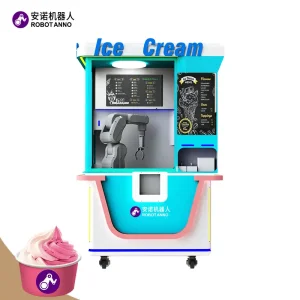
Expand your automated retail operation with our full range of robotic beverage, ice cream, latte art, and boba tea kiosk solutions.